This weekly news aggregator from Mainland China, Taiwan and Hong Kong attempts to curate the most important industry news, including impactful projects, changes in the regulatory landscape, and enterprise blockchain.
This week, the word “Evergrande” entered the vocabulary of every Western investor. After years of watching the corporate soccer team on TV and drinking their bottled water, Crypto Twitter was the last place the Shanghai Man expected to find it. After facing over $300 billion in debt, all sorts of rumors swirled, leading to its Hong Kong-listed shares dropping 80% and a massive crypto sell-off earlier in the week.
Misread their tea leaves
Western experts have mixed opinions on the matter, with CNBC’s Jim Cramer urge people protect their crypto exposure until the news becomes more stable. Prominent investor Ray Dalio is less bothered by the news, insisting that the debt is manageable and won’t do much structural damage to the economy. Whatever it is, the global media, politicians and academics have been inaccurately predicting China’s economic collapse since it became clear that the country was moving away from China. democratic and Western ideals in the early 2000s.
Therefore, it is always prudent to treat these dramatic stories with a grain of salt, especially since the Chinese government has some stabilizing leverage regarding convince other players in the economy to help. For this reason, betting on total demise means buying what China watchers believe in. Candlestick happens, and not what they believe will happen.
Yuan on blockchain
In a somewhat surprising development, Shanghai’s Lingang Special Zone has been licensed to do business using an offshore stablecoin pegged to the Yuan. This notification comes after months of strict regulation against the use of cryptocurrencies, which has led many to conclude that public blockchain may have a limited future in the country.

The stablecoin project, named CNHC, allows users to deposit assets to mint the CNHC stablecoin token. Follow website, the project plans to become the gateway of traditional finance to the blockchain world, while helping to develop the overseas use of the renminbi.
The public blockchain responsible for supporting this project is Conflux, a multi-chain network founded by academics from Tsinghua University, China’s top university. Conflux has now grown into a global network, being one of the few public chains to receive any blessing from the Chinese government. Speaking about the news, Conflux Director of Global Expansion Christian Oertel responded by saying:
“With the recent announcement of the Chinese monetary authorities in favor of Shanghai taking the lead in the free use of the renminbi in the Shanghai Lingang Special Zone, Conflux Network and Shanghai Maritime promote the exploration of the latest reform of the Shanghai Free Trade Zone to internationalize the renminbi.”
Asia’s largest surveillance company is on the rise
Cobo Custody completed a $40 million raise to complete what they call DeFi-as-a-Service. Custodian, which has maintained a relatively low profile in the Western investment scene compared to companies like BitGo, is now aiming to add more institutional avenues to DeFi.
Cobo Custody is well known in Asian crypto circles, especially in the mining scene where Cobo founder was an early pioneer as the founder of F2Pool. The Series B round is led by DST Global, A&T Capital and IMO Ventures and aims to help achieve further regulatory licenses to ensure the company stays compliant with AML legislation. Cobo Custody currently works with organizations such as Deribit, WOO X, BitMart and Babel Finance.
FTX rallies based on Huobi
In the competitive exchange space, FTX is climbing to the top in terms of volume and looks poised to topple Huobi for third place behind Binance and OKEx. This would break the hegemony that Huobi, Binance and OKEx, known as HBO, have held in the market for years. The two exchanges are already on par in terms of derivatives volume, but Huobi holds the lead in spot volume.
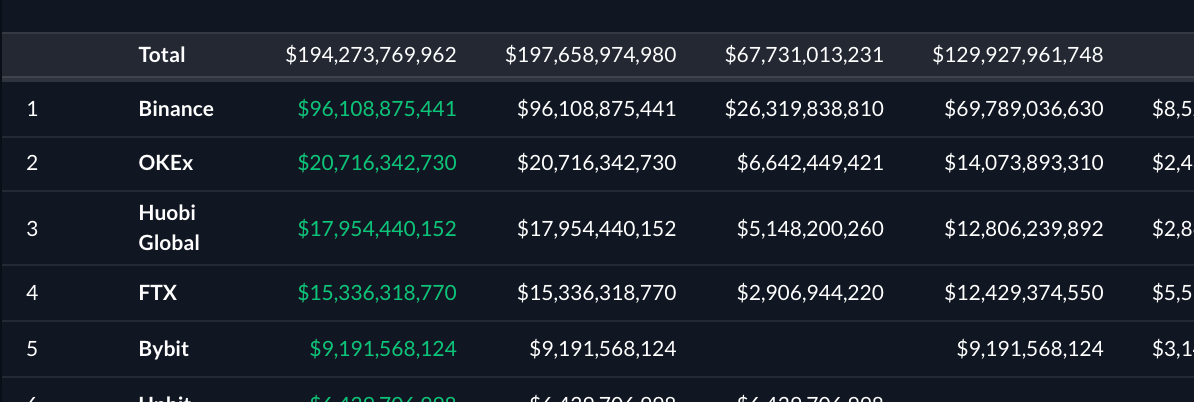
This is both a testament to FTX’s incredible growth over the past few years, and a diversified Chinese user base that is either using overseas exchanges more or simply trading less. due to China’s increasingly strict regulations. Many of China’s biggest commercial teams have moved abroad, making them less dependent on homegrown Chinese products. In response, Huobi has focused externally, focusing on products such as institutional custody in Hong Kong, where it request to have over 1 billion dollars in AUM.
On September 23, Huobi Technology announced the signing of an agreement with the Ministry of Investment and Enterprise of the Kyrgyz State to cooperate in implementing cryptocurrency trading projects. https://t.co/LCVuwYSEkG
– Wu Blockchain (@WuBlockchain) September 23, 2021
Huobi also announced that it will work with the Kyrgyz government to launch more crypto trading projects. Following the news with El Salvador, it will be interesting to see if the smaller countries of Central and Southeast Asia take a more open stance towards crypto adoption, perhaps providing some Greater Chinese players to move and grow.